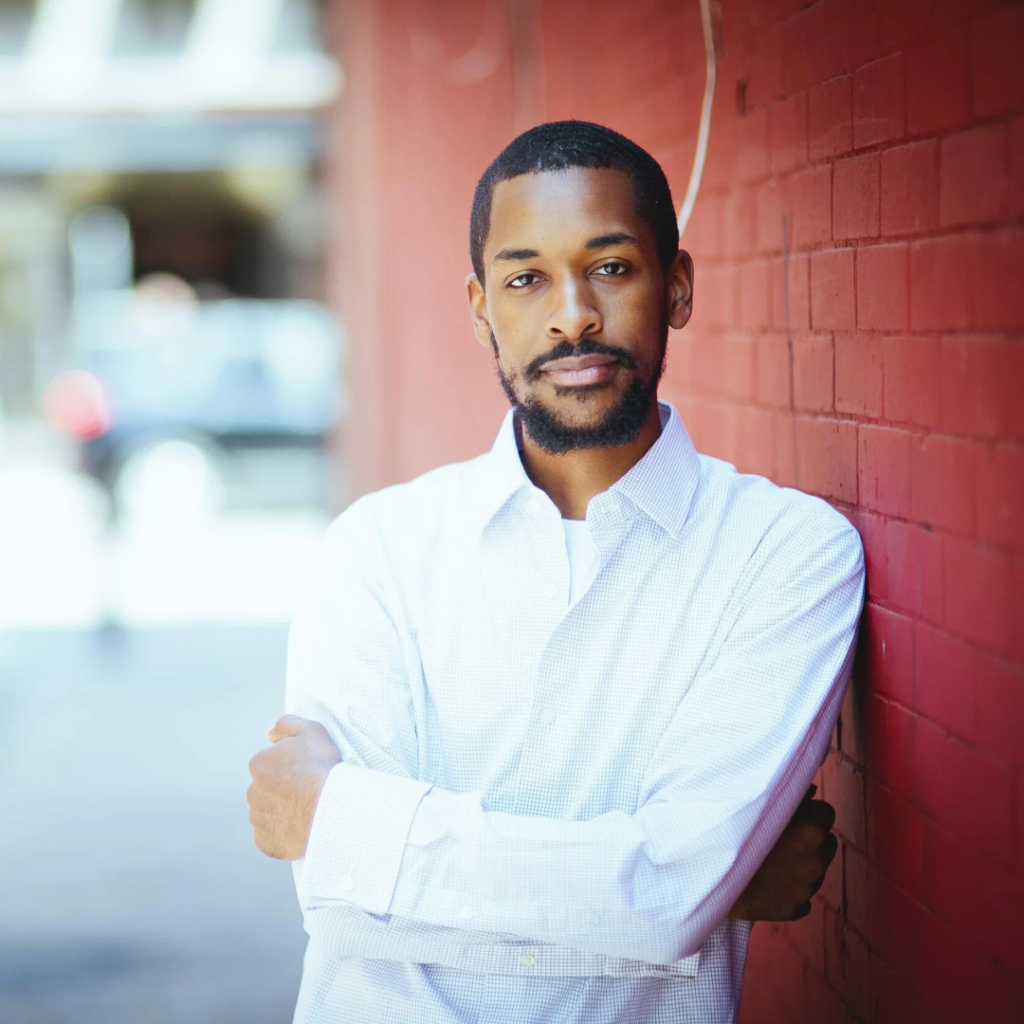
It has been a busy year for Elijah J. Thomas, BKCM’s first Jazz Program Manager. BKCM staffer Marcus Iwama asked Elijah about his experience so far, his understanding of jazz as “a boon for positive social movement,” and his vision for the program’s future.
How has it been being BKCM’s first Jazz Program Manager?
This first year has been incredible. It’s been such an inviting group to be a part of — one that has really invested in the vision of how jazz can serve the wider BKCM and Park Slope communities. It’s also been a year of discovering what’s possible within a role that has not existed until now, so I’ve been building it day by day and week by week.
What are some aspects of the role that have surprised or challenged you?
Oftentimes I’m a person who has a lot of big ideas, so it’s been interesting to understand when something can realistically be done in a short amount of time, and when something needs to be parsed out for a longer scope. This has required a lot of fascinating intentional (and inadvertent) collaboration with other programs and departments at BKCM: “How can my position best support your goals?” And vice versa.
Were you living in New York City before this role?
This coming July, I will have been here for 10 years, and all 10 years of that time has been spent in Harlem. I don’t ever want to leave if I don’t have to, in part because of its historical and social significance to jazz. In general, New York really does inform how I envision this music: a boon for positive social movement and growth.
Could you expand on that vision?
My mentors and influences have always espoused a philosophy that music – especially music we call jazz (or something resembling it) – provides us with a blueprint for possibility. That is: conceptualizing things that have yet to actually be heard or come into the public view at large. This puts jazz in a very interesting and somewhat precarious position as a musical form. It’s everything, but it’s also not any one thing at the same time.
How does that play out both historically and in the present?
Well, I’m a believer in the providential. Jazz could have only emerged within this particular American landscape that we live in: Creole influence from various folks of mixed ethnic background; instrumentation from the Bavarian provinces of immigrants from Germany and Austria; the Caribbean and South and Central American people that came to the U.S., often unfortunately, due to the transatlantic slave trade; and of course, Black peoples forced here directly from the West African coast itself. And then you have the Native American influence that already existed here in terms of spiritual and musical influence and vocalization. In this sense, jazz is only provocative in that it asks us to earnestly engage with things we might not understand. It’s a simple ask, but a heavy one.
As you look to the future, what are some exciting directions you have in mind for jazz at BKCM?
More than anything, I would love to get to a point where we’re able to more easily and accessibly invite community artists into BKCM so they can curate performances and presentations. In other words: to maximize BKCM as sort of a home base. We already do that in so many ways, from the Studio Collective to the work that our wonderful Events Team is able to give artists within our immediate sphere and beyond. I’d really love to build a model where artists who have been rooted in Park Slope and the Brooklyn jazz scene for however long are able to come in and talk about their work and how it relates to their communities. Outside the music, this is just a general blueprint for what it means to build solidarity with the people you live with. You can disagree, you can argue, you can get into some fights, but in the morning, you’re still sitting down at the table and having breakfast together.
Give us one upcoming BKCM jazz event you’re looking forward to.
On Wednesday, April 22nd, the Jazz Travelers Core Faculty performance is happening at Barbès, one of our most beloved neighborhood partner venues. All of our Jazz Travelers students come from their own school of how they learn this music, and our faculty have figured out such a wonderful, masterful way of teaching to their strengths and shared diversity. And you’ll get to hear that in real time!