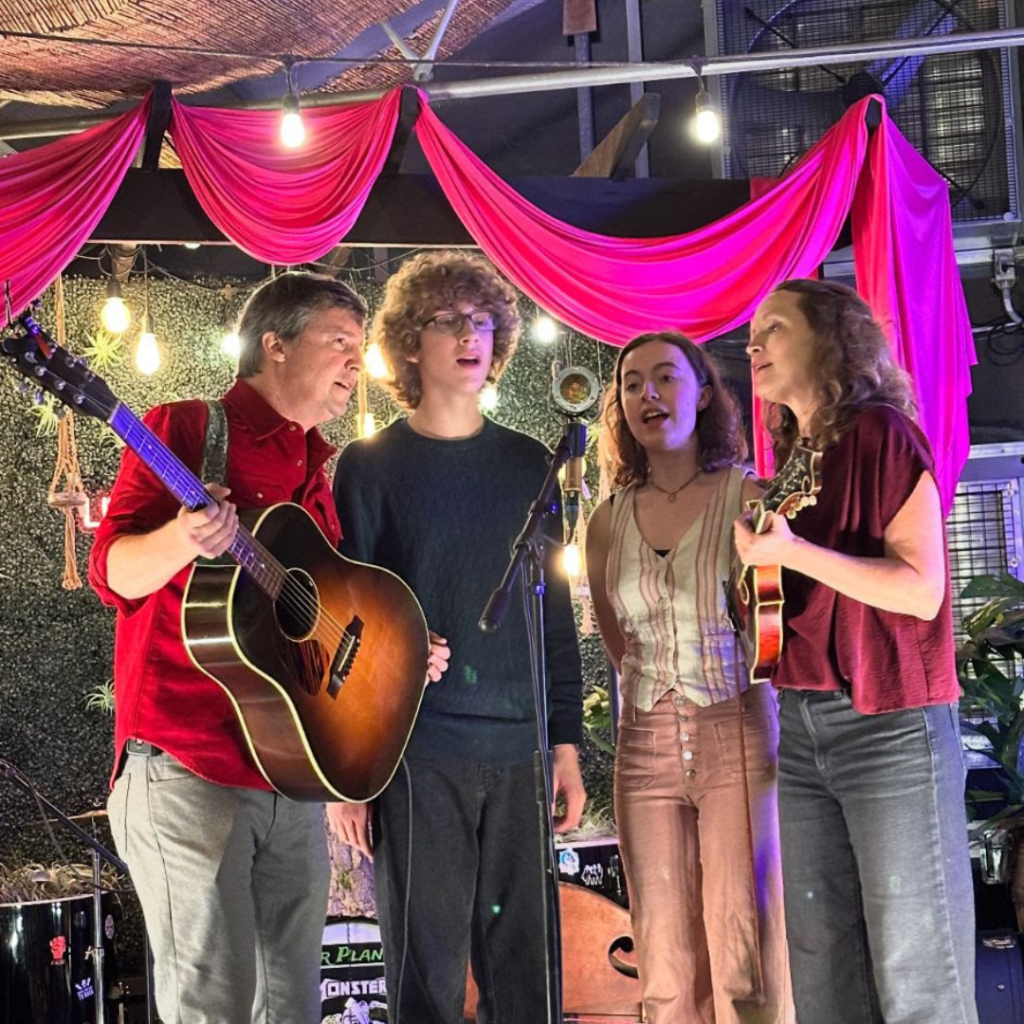
If you’ve attended BKCM’s Open Stages or House Party festivals in the past, chances are you’ve seen Katherine Slingluff on stage singing and playing mandolin alongside her husband, Andy Stuckey, in Paper Anniversary Band. This past year, she has also stepped into a new role behind the scenes, shepherding the revitalization of BKCM’s Bluegrass Program as its coordinator (and a regular participant in its monthly jams, including this month’s upcoming Square Dance!).
What may come as a surprise to some is that while Katherine grew up singing in Alabama – the heart of Bluegrass country – it was actually right here in Brooklyn where she got her first real taste of playing Bluegrass. As she recalls, “I always kind of daydreamed about playing the mandolin, but never really thought, ‘Oh, one day I could do that’. It just wasn’t on my radar until I got here (in 2007) and we had some friends who played it.” After her husband gifted her a mandolin, she began taking lessons with the Grammy-nominated musician Michael Daves – still new to the scene at the time. It was an early signal of the thriving Bluegrass community that has come to proliferate throughout Brooklyn, with recurring jams organized by Porch Stomp, Jalopy Theatre, BKCM, and countless other venues and organizations across the borough.
For Katherine, and for Bluegrass players in general, the magic is in reciprocity: “I was in choir in college, so I love harmony singing. That’s what I brought to the table with my husband. He was teaching me chords and I was teaching him harmony, and Bluegrass became an outlet for both of those dials.”
BKCM’s adult and teen Bluegrass Lab classes channel this same spirit every week. With the former led by Ken Shoji and Christian Apuzzo, and the latter by Alex Deane and a host of working Bluegrass musicians, participants come together to learn a uniquely social language – one rooted in knowing when to lead and when to step back and let your fellow jam mates shine. As Katherine explains, this kind of reciprocal energy is how the music has always been played: in circles, churches, and community centers, often without microphones. “If you’re soloing, you’re playing at one volume. If you’re playing rhythm in the background while somebody else is singing, you’re playing softer and supporting the singer.”
These roles rotate like revolving doors, welcoming musicians with different skill levels from all walks of life. And while Katherine does encourage participants to arrive with at least basic knowledge of their instrument, it’s not about getting it perfect – not really.
“It’s about getting together and learning something new every time you put yourself out there.”